Showing posts with label the wrong side of history. Show all posts

Sunday, January 31, 2016

More grounds for hope in historical unpredictability

Today I read two sweeping narratives (one by Justo González, the other by Bishop John H. R. Moorman) of church history. I had to write a brief response as part of a class on Medieval and Reformation church history, which I thought I'd post here. Alfred the Great figured prominently in both narratives. The theme of my response resonates heavily with a theme I've thought about quite a bit over the last year--call it hope in historical unpredictability.

And there was death on the Emperor
And night upon the Pope;
And Alfred, hiding in deep grass,
Hardened his heart with hope. 
-G.K. Chesterton, 'The Ballad of the White Horse'
As I read through the tumultuous history of the Church from the 5th to the 12th centuries, I was struck by the ups and downs and radical reversals throughout the period. So many unexpected challenges arose, oftentimes just when things seemed to be settling down into a beautiful Christian ideal—the Vikings sweeping through Britain, wealth corrupting the Cluniacs, Islam overwhelming the core of ancient Christianity.

Of course that's discouraging from a Christian perspective. Yet I found myself oddly encouraged by what seemed like the sheer contingency of Christian history, the sense that everything so easily could have been radically different. For me, this historical grounding offers a great sense of hope and confidence.

So many today speak as though the Church were entering a period of unprecedented decline. That's true in the sense that every historical development is unique and unrepeatable. But the Church has weathered greater crises than what we now face, and those who speak of the past as though it were a wonderful period of consistent and universal Christian faith are misguided and misguiding.

As I see it, there are two common responses when faced with the messy complexity of the Church's history. One is to reject the messiness of reality in favor of a comforting fantasy—that the Church has been a solid, stable, monolithic, and unchanging presence from Jesus to Pope Francis. The other is the more postmodern choice: since the Church is historically contingent, the current state of things must be totally arbitrary. Both are lazy options, and both work from an unexamined premise—namely, that a Church reflecting the messiness of historical life cannot also be the true body of Christ.

The reality that things could be different should not drive us to delusion or despair but instead should spur us to gratitude and determination—gratitude for the goodness of our liturgy and common prayer as precious, fragile, and by no means inevitable gifts; determination to preserve the best and mend the worst in each of our churches.

Of course, victory is in the sovereign hands of God, who will accomplish his purposes, and who is ultimately responsible for the survival and health of our Church. As T.S. Eliot wrote in The Four Quartets, "For us, there is only the trying. The rest is not our business."

Thursday, July 9, 2015

Textbooks Standards and the Limits of Human Knowledge

Catastrophic evil grabs headlines. I tend to think, though, that we're less endangered by the comparatively rare instances of spectacular depravity than by the the toxic and altogether commonplace combination of arrogance and ignorance.

Consequently, what's most exasperating about neo-Confederates and their implicit fellow travelers is their utterly absurd and totally unjustified attitude of learned superiority. They defend a repugnant government. They idolize an evil society. But what I find most annoying--rather than horrifying--is the arrogance with which they proclaim their ignorance. Historically indefensible attempts to minimize the centrality of slavery to the Confederate cause are invariably followed by the pompous demand that their opponents "read some history."

Look, I know history is complex, and that all generalizations in historical study overlook caveats and nuance and exceptions to the rule. But unless we're to do away with generalization altogether--in which case the study of history would not exist, and in its place we'd have archival cataloguing of meaningless and disconnected scraps of information--we have to live with some degree of simplification. As John Lukacs is fond of saying, "Generalizations are like brooms--they're meant to sweep."

So we must generalize at times and in places or give up on historical study. Given this inevitability, we simply have to evaluate which generalizations are more justified and which are less. And if there ever was a defensible, sweepingly true generalization, it's this: the Confederate states seceded and fought a war to defend, extend, and perpetuate an economic and social system defined by--founded and entirely dependent upon--race-based chattel slavery.

The historical evidence is overwhelming--from the declarations of secession to the arguments of southern secession commissioners to the statements of the major political figures of the Confederate States of America to the Confederate Constitution. Meanwhile, alternate theories are indefensible--bad faith distortions largely manufactured by Lost Causers after 1865 as a fig leaf to disguise their slavery-centered revolt. Southern states and the C.S.A. were eager to trample states' rights in defense of slavery. The Fugitive Slave Act, for instance, was arguably the most invasive federal law ever passed. The tariff was lower in the 1850s than in most of the previous decades,* and references to it among secessionists were sporadic and inconsistent. It's true that during the Civil War Abraham Lincoln acted outside of Constitutional bounds, but as the war went on so too did Jefferson Davis and the Confederate government concentrate power at the federal level at the expense of the states.**

It was with great interest, then, that I listened to Diane Rheem's show yesterday on the Texas textbook kerfuffle.*** Obviously I have very little sympathy with those who wish to believe that states' rights was just as central to secession as slavery--much less with those who want nonsensically to treat slavery as a "side issue."

As the panelists discussed the Texas textbook standards--which certainly appear to be frankly ridiculous--a vision of a universalized, national history education emerged from some as the solution to the Texas problem. Early on, Diane Rheem asked, "But wouldn't you think there would be sort of a standardized history text that every child in America would learn the same things about?" Throughout the show, various panelists lamented that this was not the case.

As repugnant as Texas' standards appear to be, I also have to admit that I am deeply uncomfortable with this nationalized vision for historical education. Rheem and her panelists are unconsciously subscribing to the notion that if we just get enough experts together, we can conjure up one single historical account that should suffice to explain everything to everyone.

Monday, July 6, 2015

Judging prophetic claims about history

"Good to be in the right church and on the right side of history."

I read that in all of its intense and righteous self-satisfaction, and I thought of Mrs. Turpin from Flannery O'Connor's "Revelation":
To help anybody out that needed it was her philosophy of life. She never spared herself when she found somebody in need, whether they were white or black, trash or decent. And of all she had to be thankful for, she was most thankful that this was so. If Jesus had said, "You can be high society and have all the money you want and be thin and svelte-like, but you can't be a good woman with it," she would have had to say, "Well don't make me that then. Make me a good woman and it don’t matter what else, how fat or how ugly or how poor!" Her heart rose. He had not made her a nigger or white-trash or ugly! He had made her herself and given her a little of everything. Jesus, thank you! she said. Thank you thank you! Whenever she counted her blessings she felt as buoyant as if she weighed one hundred and twenty five pounds instead of one hundred and eighty.
Mrs. Turpin's fate was to be set upon and, ultimately, set right by the ultimately-not-ironically-named Mary Grace. In absolutely no way do I wish Mary Grace's violence upon the author of those words, but I am always taken aback by the exaggerated sense of rightness in such proclamations.

 A long time ago I thought that claims about right and wrong sides to history were essentially about "a progressive view of history, whereby the superior moral standing of later generations exposes the errors of the past."* I still think that's true, but what stands out to me now is the way that a progressive vision of history functions essentially as an article of faith, entirely and wholly apart from any connection to lived history. I'm interested, in other words, in the religious zealotry that underlies progressive history.

In my last post on "Hope in historical unpredictability," I pointed out that those who make claims about sides to history "aren't making 'historical' claims, in the sense that they can be proven or supported with reference to past history. Whether the proclaimers recognize it or not, such assertions are fundamentally prophetic. That is, they are making a claim about the purposes and intentions of the author of history."

In that post, I more or less implied that statements about the right or wrong side of history should be simply ignored entirely. But that's not particularly charitable, nor am I sure it's prudent.

If, as I suggested, they are not historical claims, then they cannot be investigated and then either confirmed or falsified via the study of history. So, then, how can we evaluate them?

The answer, I humbly suggest, is to evaluate them as what they are: prophetic claims. The speaker of such claims is, essentially, claiming to be a mouthpiece for the author of history. And as I concluded my last post, "the author of history either does not exist or he is God Almighty."

It's worth noting here that prophecy in Scripture is not really about mystically predicting the future. It's about speaking God's truth, which needn't but may sometimes involve proclamations of future judgment. But in either case, the prophet speaks for God.

How, then, would you respond if someone claimed to be speaking on behalf of God?

If you do not buy into prophetic claims in general--perhaps you are an atheist or agnostic or deist or what have you, or perhaps instead you are simply a Christian who thinks prophecy ceased after the New Testament--then you can simply disregard claims about sides to history altogether. You should grant them no more credence or meaning than you assign to your average sign-waving apocalypticist shouting on a street corner.

Things are more complicated if you do not dismiss all prophetic claims out of hand.

In his essay on "Historicism," C.S. Lewis implies that a prophetic claim about history should come "with supporting evidence by way of sanctity and miracles"--and suggests that he is not capable of judging in such an instance. Presumably, Lewis saw that as the job of the Church. That is pretty much what I think--that prophetic claims ought ultimately to be judged by the Church.**

But there are places where the Church has already spoken--where Scripture is resoundingly clear, or where ecumenical councils have made relevant statements, or where the common prayer and practice of the Church make a conclusion unavoidable. And we know, as I've said before, how the story ends.

So, I'd humbly suggest, if someone's claiming that the author of history is saying something in contradiction to what we know to be true about God or what we know to be true about the end of the story, then we can safely reject it as nonsense.

---

*At the time I noted another possibility: Perhaps the man who was shouting about the wrong side of history wasn't really a believer in History as Progress. "Perhaps," I wrote, "he fancies himself a hardened realist. He's merely stating that victors get first dibs at writing history textbooks, and he intends to win. He intends, in other words, to sit in the chair, become the power that be is? and say what's what." He's saying, in other words,  that you'll be on the wrong side of history because I'm going to make sure you lose, and then I'll write the history of your defeat. I wrote that with my tongue firmly planted in cheek, but now I'm not so sure that's an implausible reading. In fact I think it's likely that faith in History as Progress goes hand-in-hand with the desire to demonize, defeat, and annihilate the Enemies of Progress.
**In response to this post, Daniel Silliman has rightly pointed out that the two options I've outlined do not fairly cover the possible responses to prophetic claims. He's absolutely correct, and I did not mean to suggest that wholesale dismissal and "the church should judge" are the only possible responses. Many evangelicals, for example, might respond that each individual should judge by Scripture and the guidance of the Holy Spirit. I merely want to say that claims about the sides of history should be weighed in the same manner as you would judge religious claims--however you do so. My primary targets--to drop the whole indirect pretense real quick--are those who think religious claims are fine as privately held beliefs but have no place in the public square, yet also bludgeon their political opponents with "wrong side of history" language.

Thursday, June 25, 2015

Hope in historical unpredictability

The fellas over at First Things--along with their allies and fellow travelers (and, uh, frenemies) are quite a gloomy lot these days. There's a distinct sense that orthodox Christianity is doomed in American society. Many in this cohort have shifted their attention from strategies of engagement in the public square to how best to deal with impending exile from mainstream American life. The so-called "Benedict Option," articulated most popularly by Rod Dreher, has been gaining traction. Michael Hanby's profoundly despairing essay on "The Civic Project of American Christianity" was widely and heatedly discussed.

It is in this context, then, that I find Michael Brendan Dougherty's most recent column at The Week rather refreshing. Dougherty essentially says two things.

He points out how many seemingly unstoppable trends in the past half century or so were reversed or undone in ways no one predicted:
But history has surprising turns, ones that can be hard to see even in retrospect. It is possible to imagine a future in which 2015 doesn't augur the beginning of conservatism's final descent, but instead represents a temporary nadir. 
...Many Cold War conservatives were convinced that communism would triumph over the West. Conservatives of the late 1980s and '90s thought that the increasing crassness of popular culture and the rise in crime were related and unstoppable. Entirely wrong, all.
Dougherty then highlights many societal trends that, while apparently secular and anti- or post-Christian in nature, have surprising resonance with the concerns of conservative Christians. He points to feminism's relatively recent turn away from unfettered sexual libertinism and towards a genuine concern over the destructiveness and danger of casual sex. He notes that "the desire for organic, natural, and sustainable products" should be very amenable to true conservatism--which should be about conserving, after all. He highlights the ways that union organizers resists statism and New Urbanism emphasizes humane scale and beauty. In short, not all is bleak.

A decade ago, historian John Lukacs saw these surprising convergences. "A great division among the American people," Lukacs wrote, "has begun--gradually, slowly--to take shape: not between Republicans and Democrats, and not between 'conservatives' and 'liberals,' but between people who are still unthinking believers in technology and economic determinism and people who are not." Later in the same book, he quoted Wendell Berry's similar thoughts. "It is easy for me to imagine," said Berry, "that the next great division will be between people who wish to live as creatures and people who wish to live as machines."

Ultimately, though, the particular hopeful trends Dougherty mentions are less important than his other, more basic concept. History is unpredictable. Trends that seem unstoppable stop. New trends emerge from totally unexpected places.

Some years ago I wrote some thoughts about Tina Fey, Mark Twain, and racism:
Consider: if we today have problems discerning whether 30 Rock is racist, imagine how much more difficult this would be in a century. When people with inevitably different perspectives from another culture with its own constructions of race and society attempts to parse commentary, humor, and racism within 30 Rock, some of them are likely to think, wrongly, "Wow, that is actually pretty racist." And if, in one hundred years, that discussion actually is occurring, Tina Fey's work and legacy will have approached Mark Twain's. 
I later connected that thought with a broader point about the unpredictable judgments of our progeny--the frightening reality that what we see as our best, most "forward-thinking" qualities might come in for vociferous condemnation somewhere down the line:
At the end of last year I wrote that Tina Fey's not-controversial-except-to-neocon-pundits joke about Mark Twain might actually be a brilliant anticipation of the totally unfair ways we'll be judged by our descendants. And it's that unpredictability--turning a prescient, humane condemnation of racism into racism itself--that makes me think worrying too much about our grandchildren's judgment is a waste of time. They'll probably have bad taste.
More to the point today: we surely needn't worry about those proclaiming right and wrong sides to history. After all, they aren't making "historical" claims, in the sense that they can be proven or supported with reference to past history. Whether the proclaimers recognize it or not, such assertions are fundamentally prophetic. That is, they are making a claim about the purposes and intentions of the author of history.

And the author of history either does not exist or he is God Almighty.

Friday, January 30, 2015

Stephen Greenblatt's The Swerve is not a new book, but it's still plastered all over the history section at Barnes & Noble--with National Book Award and Pulitzer Prize prominently displayed--so it's still worth pointing out that it is a distinctly bad book.

Jim Hinch's old and somewhat infamous takedown of The Swerve, then, still merits attention:
Simply put, The Swerve did not deserve the awards it received because it is filled with factual inaccuracies and founded upon a view of history not shared by serious scholars of the periods Greenblatt studies. That such a book could win two of America’s highest literary honors suggests something doesn’t work in the awards system itself.
Read his whole review here. It's worth your time if (a) you've read the book (b) you're intrigued by it (c) you still talk about the medieval period as some benighted "Dark Ages" where learning died or (d) you tend to assume that the big non-fiction book awards reward quality.

Saturday, January 24, 2015

Lukacs and the "Law of Accelerating Returns"

Alan Jacobs has a nice little post on what he calls "Kurzweilian Whiggery"--Ray Kurzweil being the prominent "futurist" who is all kinds of optimistic about how technology will solve the world's problems and help us live eternally (as disembodied minds, anyway*). Jacobs pushes back against the assumption that change and progress are always speeding up--in particular, Tim Urban's assumption that "so much more change happened in the most recent 30 years than in the prior 30" due to the so-called "Law of Accelerating Returns."

In response, Jacobs proposes "a thought experiment, in the form of a few questions."
Did automobiles change more from 1955 to 1985, or from 1985 to 2015? 
Did television change more from 1955 to 1985, or from 1985 to 2015? 
Did household appliances change more from 1955 to 1985, or from 1985 to 2015? (Think for instance about the prevalence of air conditioning.) 
Did space exploration change more from 1955 to 1985, or from 1985 to 2015? 
Did military weaponry change more from 1955 to 1985, or from 1985 to 2015? 
Did cancer treatment change more from 1955 to 1985, or from 1985 to 2015?
Jacobs' thinking aligns with that of historian John Lukacs throughout much of his work. Lukacs pushes the point even further than Jacobs. In his history of America in the twentieth century, A New Republic, Lukacs points out that most of the transformative conveniences of modern life were actually invented before the Great War started in 1914. Since then what we've mostly seen are not completely new inventions, but simply improvements on previous inventions.

In a little while, I'll be doing a thought experiment with my students. I split the class into three groups. Each group brainstorms particular kinds of inventions: one group thinks about various means of transportation, another thinks about household luxuries/appliances, and a third thinks about means of communication.

Then I ask them to guess when each thing was first invented: before 1865, after 1914, or in between? It's an illuminating activity because it helps them realize how little was invented after 1914.

Consider these pre-1914 inventions: the telephone, the phonogram, motion-picture technology, the radio, the automobile, internal plumbing, refrigeration, washing machines, the lightbulb, the airplane, the elevator... the list goes on. If I recall correctly, Lukacs--originally writing in 1984**--suggests that the only comparably significant things invented after 1914 are air-conditioning and the personal computer. Now you could add the Internet, and maybe you could make an argument for the microwave and nuclear power.

But, in any case, the point still stands: practically everything we use just improves on inventions made before 1914. That's remarkable.

There is an important distinction to note between the arguments of Tim Urban and Lukacs: Urban, using Back to the Future as a reference, is dealing specifically with how the average American's life changed, whereas Lukacs is referring to the original invention of a transformative technology. Obviously there's a lag between the latter and the former--decades passed, for instance, between the invention of the telephone and the existence of telephones in middle-class households.

This reflects Lukacs' greater emphasis throughout his works on how thinking itself has slowed down in the twentieth century, even as the material conditions in which we live seem to be changing so drastically and dramatically. In a number of his books, he notes that the most revered and revolutionary thinkers at the beginning of the twentieth century--Freud, Marx, Darwin, and Einstein--retained positions of unparalleled renown at the end of the century. Of course, each figure's reputation has waxed or waned over the years, but it remains the case that the thinking of these four figures--and contentious debates about that thinking--continue to dominate our intellectual landscape well over a hundred years later. Lukacs points out that in no previous century of the Modern Age could this be considered the case.

In other words, despite the obsessive optimism of Kurzweil and the futurists, we live in a remarkably stagnant age. This is so, Lukacs says, because we are not really living within an age, properly speaking. Rather, we are living in what he calls a "dark interregnum" between ages. The widespread usage of "postmodern" is one sign of our interregnal state--a self-conscious recognition that we are living past the end of the Modern Age.

No one in the the ancient or medieval world knew they were living in Antiquity or the Middle Ages. These designations came about later, as labels applied in hindsight by the self-consciously modern inhabitants of the Modern Age. The division of the world into ancient, medieval, and modern is a construction of the modern imagination. But this does not necessarily make these designations arbitrary or artificial--because consciousness is a part of reality, rather than a superimposition onto it, and it is only through constructions of models or stories that human persons can grasp reality.

So, despite the varied, sometimes ambiguous, and often contradictory uses to which it is put, the term "postmodern" matters. It reflects and is itself a part of the era in which we live--here in the residue and remnants of modernity. Our ideas, our philosophies, and our arguments still revolve around those four figures from a century ago. This may not be so within Academia proper--Heidegger, Foucault, Derrida, and others having far more traction than Freud, Marx, Darwin, and Einstein. But the former figures never have, never will push much beyond the bounds of the academic world. There are no "Heideggerian slips," no "baby Derridas." Nor will you ever find Fox News fulminations against the hidden Foucaldian agendas of liberal politicians.

In the culture at large, those four from the last century remain the inescapable giants of our new century. We venerate them, or we denounce them. We worship them, or we criticize, castigate, and condemn them. The one thing we do not do--cannot do--is ignore them.  Because here amidst the ruins of the Modern Age, all we have left are the tired old thoughts of dead old men.

*A plug for the wife's workplace: On Volume 118 of Mars Hill Audio, Gilbert Meilander interacts with some of Kurzweil's thinking and does a good job of explaining the metaphysical implications of bodiless thinking.
**The original edition was published in 1984, while a second, lightly-revised and retitled edition came out in 2004.

Monday, August 11, 2014

Wars of Religion or State?

My wife's boss sent me "'A Fire Strong Enough to Consume the House:' The Wars of Religion and the Rise of the State" (PDF available here) by theologian William T. Cavanaugh.

I can't recommend it highly enough.

Cavanaugh's argument has three basic parts. I find the first part convincing. The second part seems reasonable but is way outside of my knowledge, so my ignorance prevents me from endorsing it. The third part is... well, you'll see.

First, Cavanaugh argues that the classic picture of the "wars of religion" is completely wrong. Typically these early modern conflicts have been depicted as the last gasp of medieval religious violence--wars motivated and fueled by religious zealotry. In this telling, the modern state was essentially invented as a result of the terrible violence wrought by religion. It stepped into religious chaos to become the neutral "peacemaker" standing between Catholic and Protestant hatred.

Cavanaugh argues, instead, that the "wars of religion" are better depicted as a fight between the old ecclesial order of the medieval world and an emerging absolutist state which required religion to be relegated to the private sphere. In other words, the modern state was not a peacemaker between the two sides but was instead itself one of the sides in the conflict--and, as it turns out, the victorious one.

One implication, which he does not make explicit, is that, rather than being the last gasp of medieval warfare, the "wars of religion" are actually the first modern wars and are better lumped in with, say, the world wars of the 20th-century than the Crusades.

His second proposition is that the concept of "religion" as a general term for (private) religious beliefs is a modern invention, and that this innovation came hand-in-hand with the rise of the absolute state. As I implied before, this seems reasonable, but I don't know the period well enough to pass judgment at all.

And then comes the third part. Here's an excerpt:
In an article entitled "War Making and State Making as Organized Crime," sociologist Charles Tilly explores the analogy of the State's monopoly on legitimate violence with the protection rackets run by the friendly neighborhood mobster. According to Tilly "a portrait of war makers and state makers as coercive and self-seeking entrepreneurs bears a far greater resemblance to the facts than do its chief alternatives: the idea of a social contract, the idea of an open market in which operators of armies and states offer services to willing customers, the idea of a society whose shared norms and expectations call forth a certain kind of government." States extort large sums of money and the right to send their citizens out to kill and die in exchange for protection from violence both internal and external the State's borders. What converts war making from "protection" to "protection racket" is the fact that often States offer defense from threats which they themselves create, threats which can be imaginary or the real results of the State's own activities. Furthermore, the internal repression and the extraction of money and bodies for "defense" that the State carries out are frequently among the most substantial impediments to the ordinary citizens' livelihood. The "offer you can't refuse" is usually the most costly. The main difference between Uncle Sam and the Godfather is that the latter did not enjoy the peace of mind afforded by official government sanction.
Whew. More:
The State is involved in the production, not merely the restraint, of violence. Indeed the modern State depends on violence, war and preparations for war, to maintain the illusion of social integration and the overcoming of contradictions in civil society. [...] The use of the Church's own practices of binding and loosing is not, however, a call for the Church to take up the sword once again. In fact, it is precisely the opposite. I have contrasted Church discipline with State discipline in order to counter violence on behalf of the State, which has spilt so much blood in our time. Contesting the State's monopoly on violence does not mean that the Church should again get a piece of the action, yet another form of Constantinianism. What I have tried to argue is that the separation of the Church from power did nothing to stanch the flow of blood on the West's troubled pilgrimage. The pitch of war has grown more shrill, and the recreation of the Church as a voluntary association of practitioners of religion has only sapped our ability to resist. The discipline of the State will not be hindered by the Church's participation and complicity in the "public debate." Discipline must be opposed by counter discipline.
And the conclusion:
We must cease to think that the only choices open to the Church are either to withdraw into some private or "sectarian" confinement, or to embrace the public debate policed by the State. The Church as Body of Christ transgresses both the lines which separate public from private and the borders of nation-states, thus creating spaces for a different kind of political practice, one which is incapable of being pressed into the service of wars or rumors of wars.
Think on that for a while, as I am doing right now, and then go read the whole thing (again, you can get it in PDF form here). Then, consider reading his 2009 book titled The Myth of Religious Violence, which I would love to find time to read myself.

Monday, July 28, 2014

Hart's Amibition

As I'm reading and quoting from David Bentley Hart's Atheist Delusions, I thought I ought to include a brief explanation of just what the book is. The book's subtitle is The Christian Revolution and Its Fashionable Enemies, and essentially what Hart has written is a polemical "historical essay."

Hart's book overtly responds to the ridiculously bad version of history the New Atheists are promulgating. Given how notoriously terribly New Atheist versions of history tend to be, this is neither difficult nor particularly ambitious. The New Atheists constitute Hart's explicit target, and they certainly formed the inspiration for this volume, but he's actually up to something significantly more ambitious. What the New Atheists tend to present is a cartoonish caricature of triumphalist history permeated by immense self-satisfaction and deep scorn for the past--and the people who inhabited it. It is patently ridiculous. But in reality it's just an absurdly exaggerated and excessively simplistic version of a narrative of history that is much more common, perhaps even universal, in the contemporary West.

So while Hart ostensibly takes aim at the historical misconstruals of New Atheists, his real target lies behind them. He's really taking aim at the whole modern account of itself: "the reigning historical narrative that most of us imbibe from school, the press, popular entertainment, even frequently our churches--in short, the entire fabric of our society."

So. Yeah. Ambitious.

Hart recognizes that serious historians have mostly abandoned the modern self-account of triumph over superstition, but he also notes, correctly, that this tired narrative retains most of its cultural cache. In contrasting the two--serious history versus popular accounts--he paints a portrait of the academic historian that is at once marvelous, heroic, sad, and more than a little pitiful. Which is to say he pretty much nails it:
For everyone whose picture of the Middle Ages is shaped by the dry, exact, quietly illuminating books produced by those pale dutiful pedants who squander the golden meridians of their lives prowling in the shadows of library stacks or weakening their eyes by poring over pages of barely legible Carolinian minuscule, a few hundred will be convinced by what they read in, say, William Manchester's dreadful, vulgar, and almost systematically erroneous A World Lit Only by Fire. After all, few have the time or the need to sift through academic journals and monographs and tedious disquisitions on abstruse topics trying to separate the gold from the dross. And so, naturally, among the broadly educated and the broadly uneducated alike, it is the simple picture that tends to prevail, though in varying shades and intensities of color, as with any image often and cheaply reproduced; and the simple picture, in this case, is the story that Western society has been telling about itself for centuries now.

Wednesday, May 22, 2013

Story and the Church

I gave this as a faculty devotion. In some ways it's a continuation of my earlier two posts on "Teaching History, Confronting Suffering." In other ways, perhaps, it's a response to those posts.

I’m going to start with a passage from The Historian’s Craft, a classic by the French historian Marc Bloch. The book is famously unfinished—unfinished because, in the midst of its composition, its author, who was a member of the French Resistance, was tortured and executed by the Gestapo.

In it Bloch writes, “Christianity is a religion of historians. Other religious systems have been able to found their beliefs and their rites on a mythology nearly outside human time. For sacred books, the Christians have books of history, and their liturgies commemorate, together with episodes from the terrestrial life of a God, the annals of the church and the lives of the saints. Christianity is historical in another and, perhaps, even deeper sense. The destiny of humankind, placed between the Fall and the Judgment, appears to its eyes as a long adventure, of which each life, each individual pilgrimage, is in its turn a reflection. It is in time and, therefore, in history that the drama of Sin and Redemption, the central axis of all Christian thought, is unfolded.”

Indeed, the Christian faith rests wholly upon the historical reality of Christ crucified and Christ risen again. As St. Paul writes, "...if Christ has not been raised, your faith is futile and you are still in your sins. Then those who have fallen asleep in Christ have perished. If in this life only we have hope in Christ, we are of all people most to be pitied."

It matters, in other words, that Christ was actually—historically, physically—resurrected. For if he only served as a good example and the resurrection is only spiritual and non-corporeal, Paul indicated, we're a bunch of fools who deserve pity. It’s the story of Christ’s resurrection that lends our faith the weight of reality.

A bit earlier in the same letter, St. Paul corrects the Corinthian church’s abysmal failures with a story. “For I received from the Lord,” he says, “what I also delivered to you”... and then he tells the story of the Lord's supper. And so, when we take communion, we also tell that story. And retell it, over and over again until he comes again. Our ecumenical creeds, too, are stories. The heftiest portion of the Nicene Creed tells who the Lord Jesus Christ is through story—it tells us he was begotten of his Father before all worlds, that all things were made through him, that for us men and for our salvation he came down from heaven, and was incarnate by the Holy Ghost of the Virgin Mary and was made man; he was crucified also for us under Pontius Pilate; he suffered and was buried, and the third day he rose again...

The four gospels tell—and between the four of them, retell—story after story after story. The Old Testament is filled with books of history—and the books that aren’t historical, strictly speaking, are stuffed with stories too. I could go on and on.

I have spent a good while thinking about what it means to be a people of history—a storied people. I am thinking about this as a Christian first and foremost, but also secondarily as a historian, and now as a teacher of American history at a Christian school.

And I have to admit that I am extraordinarily cautious about the uses to which I put history.

Tuesday, August 21, 2012

Teaching History, Confronting Suffering (Part 2 of 2)

Read Part 1 here.

Sometimes God tells you why you’re suffering or have suffered. He parts the clouds and speaks. That’s certainly possible, and I believe that it happens.

I believe, too, that God’s grace can work itself out in suffering and violence. Flannery O’Connor, more than anyone or anything else, has expanded my sense of how God’s grace operates amidst evil. In certain ways her stories have operated as a kind of commentary on Biblical violence for me, causing me to reconsider what God is up to in stories I have known since earliest childhood. In fact, there are some times when I want to say to her, “No, Flannery, God cannot work in this. This is too much.” I won’t get into it because it’s frankly too difficult to discuss, but there’s a moment at the end of one of her stories where the devil rapes a boy, and God ends up using that as a means of grace. I am deeply uncomfortable with that. But then I am equally uncomfortable saying, “No, God cannot come into this situation. It’s too gritty and nasty for him.” We serve a God, after all, who has entered into human wickedness and fully experienced its consequences.

Although I firmly believe that God works through suffering and evil, and I know that he sometimes condescends to reveal why we suffer, I remain skeptical of attempts to piece out concrete and digestible explanations for suffering. I am hesitant to do it with my own suffering, and I absolutely refuse to do it with the suffering of others. O’Connor can do it in a story with fictional characters, where she is essentially assuming the omniscience of God, but I would feel an impulse to slap anyone who decided to do the same with an abuse victim. The prophets can do so because God has divinely revealed his will to them, but I am very skeptical when people try to explain God’s prophetic purpose in, say, the First World War.

Friday, May 6, 2011

Truth Claims

Two things I read and heard, respectively:

-"This is fact."
Singular, no article. Some of us are so bold as to talk about "a fact" or "facts." Some even claim to have "the facts." The great ones declare what is and what most certainly is not... fact.

-"You're gonna be on The Wrong Side Of History!"
The gentleman who shouted this was protesting the powers that be. He didn't, you know, shout the capital letters out, but he did repeat those five words, as though reciting a liturgy or mantra.

He's probably implying a progressive view of history, whereby the superior moral standing of later generations exposes the errors of the past. Unfortunately for him History went ahead and Progressed his particular group into the current exploited/oppressed state he's decrying. One would think (I think) he'd have to doubt either one thing (his faction's rightness or favored status in History) or the other (History as Progress).

It's possible, though, that he's no idealist at all. Perhaps he fancies himself a hardened realist. He's merely stating that victors get first dibs at writing history textbooks, and he intends to win. He intends, in other words, to sit in the chair, become the power that be is? and say what's what.

Monday, February 28, 2011

The Historian-Pundit: Oxymoron or Moron?

The American Historical Association is encouraging historians to engage issues of public concern more actively. I am not sure I think that good historians are or should be particularly effective in such a role, and I fear that this may encourage historians to become pundits.

I strongly agree with the somewhat skeptical response by Tomiko Brown-Nagin at the Legal History Blog. Dr. Nagin, who teaches American social and legal history at UVA, writes that the historian may not be suited to advise on policy in large part because of
the "problem" of historical indeterminacy. Good history is multi-layered and may not provide definitive answers to questions posed. Historians may discover new facts or offer interpretations that illuminate public controversies, but they do so—at their best—through nuanced discussions of the past. Such nuance often make history less "usable" in the context of policy and adversarial legal settings—where clear answers and easily packaged explanations of complex phenomena have the greatest currency.
She does suggest that historians should play a corrective role of sorts in the public sphere.
When history is featured in policy battles or litigation, partisans much less inclined than professional historians to tell the truest story possible, given the available evidence, often are the first to trumpet historical arguments. Or, the partisan in question might be a professional historian, one who clings to the virtue of "objectivity" while engaging in partiality—excluding certain actors, viewpoints, events, interpretations, and analytical tools.

In these situations and others, perhaps it is irresponsible to disengage from public conversation. And one can appreciate the request to "say something historical!" and oblige. Context is everything.
Again I can't agree more.

I do not think historians ought to be saying things like, "History teaches us that [insert highly dubious claim]." There are fewer more misleading phrases than "history shows/teaches..." That really means, "I am using historical evidence [of whatever accuracy or truth] to argue that..."

I do think historians ought to complicate simplistic pictures and correct untruths, and that, if they feel so inclined and are capable, they ought to do so for the public.

This brought to mind a passage from Timothy Garton Ash's In Europe's Name (1993). He writes
…the end of Soviet communism and of the Cold War posed the largest questions to those disciplines, or branches of disciplines, that made some claim to quasi-scientific prediction.

Most historians make no such methodological claims. Some would agree with E.H. Carr that they should at least have in their bones the question ‘whither?’ as well as the question ‘why?’ Others would dispute even that. Yet in his wry way, Adenauer identified a real problem. It is surely reasonable and right for politicians to ask historians to make informed personal guesses–so long as everyone clearly recognises that they are just that: personal guesses. These guesses are related to the history they write, but separable from it. The history may be good but the guesses bad–or even vice versa. . . . [These guesses] can be overtaken by events in a way that the historical analysis cannot be. For the one thing historians can confidently predict is surprises.
I have to add that Garton Ash has been doing quite well for himself writing on current events for the Guardian.


Do read the rest of Dr. Nagin's excellent post. And a hat tip to Peter Haworth at FPR for bringing Dr. Nagin's post to my attention.

Saturday, December 4, 2010

Neo-cons misinterpret Tina Fey, take Fey to task for misinterpreting Mark Twain

Tina Fey, accepting the Mark Twain Prize:
I hope that, like Mark Twain, a hundred years from now people will see my work and think, "Wow, that is actually pretty racist."
 Pretty funny, right? Wrong! say the neo-conservative pundits.

Aaron Goldstein in The American Spectator:
Well, what do you know? Tina Fey still isn't funny.
Philip Terzian in The Weekly Standard:
You can say a lot of things about Mark Twain, and a lot of critical things, but calling his writings racist is plain ignorance. Which, considering Tina Fey’s cerebral reputation, and the glittering credentials of her Kennedy Center audience, makes her joke -- and the attendant laughter and self-congratulatory applause -- more depressing than anything Mark Twain ever wrote or said.
The Spectator blog is pretty easy to absorb and dismiss, so I'll get that out of the way first. Goldstein, one of those post-9/11 neo-conservatives, was naturally too busy "watching Sarah Palin on TLC" to bother with the Mark Twain Prize.

The "still not funny" comment refers to a blog he wrote back in June after the Kennedy Center announced that Fey would win the Mark Twain Prize. It's worth a perusal, if only for his delusional idea of Palin as a good sport and his hilarious list of comics better than Fey. Who did Goldstein prefer? Bill Cosby. Carol Burnett. Robin Williams. Thank you, sir, for pointing out three of the funniest comedians of the Johnny Carson era. Perhaps next you can explain how Tina Fey just doesn't match up to the high standards of Groucho Marx or Charlie Chaplin or, hell, Mark Twain.

Goldstein's bah-humbuggery, by the way, immediately reminded me of Jarem--one of those amazing, random, non-recurring 30 Rock characters.

---

I have a bit more to say about Philip Terzian's comments in the Weekly Standard. While Goldstein's harumphing can be lightly dismissed with an eye-roll, Terzian's assumption and claim that Fey calls Twain's works racist bears a little more scrutiny.

By way of disclaimer: Bear in mind that such scrutiny involves taking Fey's joke too seriously, but I want to show how, even if, like Terzian, you are inclined to treat the joke with all the seriousness of an audience at a White House Correspondents Dinner, Terzian's conclusion remains dead wrong.

On a technical level it's simply not true. She doesn't call his writing racist. She suggests that now, a hundred years on, people read his stuff and say, "Wow, that is actually pretty racist." And what do you know?

"Technicality!" the neo-cons shout. "Side-stepping the issue!" because obviously she's implying that his writing are racist. She's not. Because Terzian completely fails to understand what Fey's joke is saying and implying, he tears into Fey for failing to understand Twain's writing. Which is, I do believe, truly ironic.

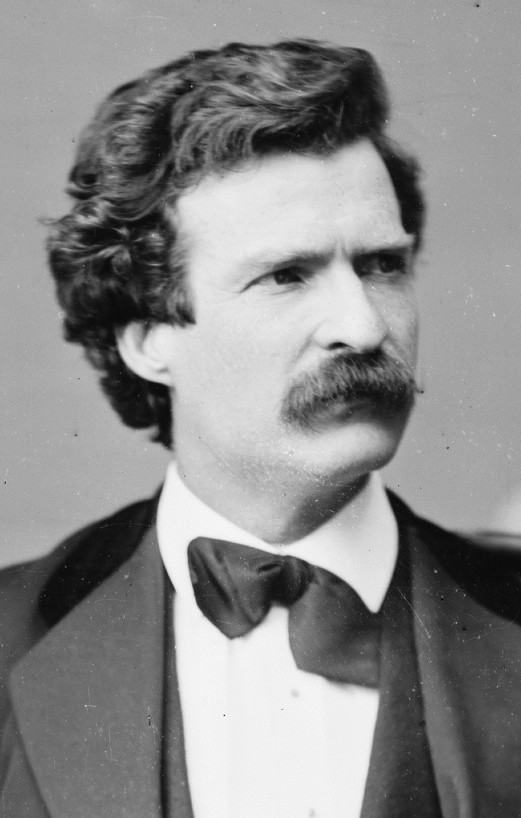
[I think that's ironic, right? Speaking of which, check out Twain's "ironic" mustache. What a hipster!]

Three notes:

1. If Tina Fey is calling Twain's writing racist, she's calling her own work racist too. [Here you might say that it's a joke. Good point. Since you understand that it's a joke and not to be taken too seriously, why are you still reading? You can't arbitrarily decide she's joking about her own work being racist but serious about Twain's work being racist. You should have stopped reading after the disclaimer.]

2. If she's calling Twain's work racist, she's implying that whatever anyone calls racist is racist. And if Tina Fey thought that, she certainly wouldn't be making the show she is making.
 
3. If Terzian actually watched Tina Fey's work outside of her ubiquitous Palin impersonations, he might not have misunderstood Fey. Rather than accusing Twain of racism, Fey actually made an ambitious statement about her work's interaction and engagement with racism. He might see that her comment is not the back-handed compliment it seems at first but is instead a nod to Twain's legacy.

30 Rock (which I'll take here as the high point of Fey's work) often portrays stereotypes about race in ways that are funny and slightly uncomfortable. The scenes on race offer a look into our society's foibles and weaknesses. Tina Fey plays with racial assumptions, and she rarely, if ever, gives her audience the relief of immediately dismissing or destroying the stereotypes. By embodying our cultural preconceptions about race, she is--in a healthy and generally hilarious way--engaging in a racist dialogue. That she does so without the acceptable Dead Serious Face opens her up to charges of racism from small minds.

Consider: if we today have problems discerning whether 30 Rock is racist, imagine how much more difficult this would be in a century. When people with inevitably different perspectives from another culture with it's own constructions of race and society attempts to parse commentary, humor, and racism within 30 Rock, some of them are likely to think, wrongly, "Wow, that is actually pretty racist." And if, in one hundred years, that discussion actually is occurring, Tina Fey's work and legacy will have approached Mark Twain's.